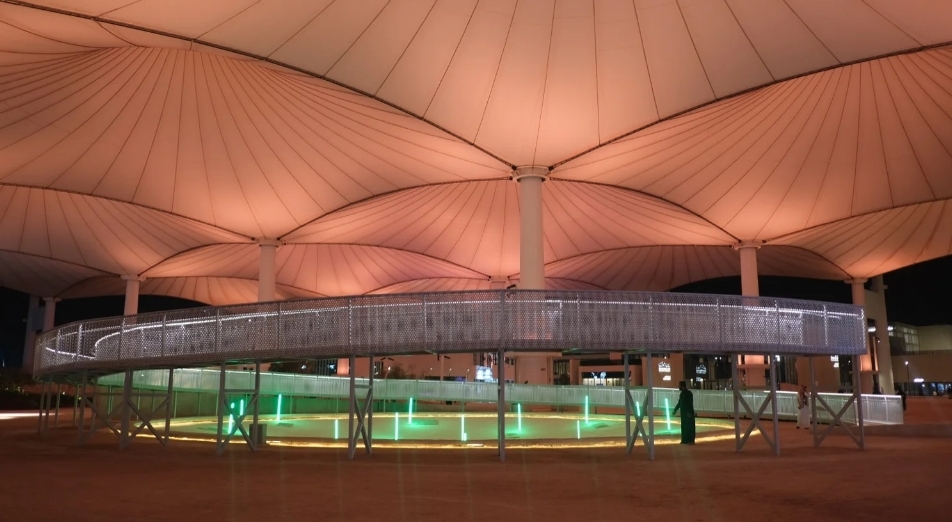
Saudi Arabia’s Islamic Arts Biennale (IAB), on view in Jeddah through April 23rd, is best experienced at night. The outdoor works, subject to the rising and setting sun, are heightened by light and sound. During the day, narrow streams of sunlight pour through the small oculi in the space’s canopied roof, evoking sundials and the way times for prayer are dictated by natural light.
Housed within an annual transit point for pilgrimage—King Abdulaziz International Airport’s as-yet-unused Western Hajj Terminal—IAB’s inaugural edition is led by artistic director Sumayya Vally alongside a curatorial team of prominent architects, archaeologists, and Islamic art historians. Divided into central religious tenets, the exhibition is presented under the theme of Awwal Bait, a transliteration of “First House” in Arabic. It also complicates the notion of “house”—which traditionally refers to the Kaaba in Mecca, the holiest site in Islam that Muslims orient towards during prayer—to include more abstract notions of ritual both inside and outside the body, within and beyond linear time.
The historical artifacts on view—almost 300 in total and mostly in a satellite exhibition that brings together Islamic art collections from Kuwait, Egypt, Tunisia, Qatar, Oman, Mali, Uzbekistan, and Azerbaijan—chart a lineage of Islamic arts in what otherwise feels like a contemporary show about lived traditions in different contexts and geographies. The resulting presentation has provoked a lot of debate among thinkers and curators from the region about how inclusive visions of Islamic art can be today vis-à-vis the previously monolithic ways in which religion was practiced by the Kingdom of Saudi Arabia
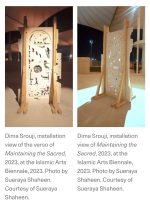 Dima Srouji has pieced together fragments of colored glass, replicas of the 30 destroyed windows in Dome of the Rock and Al-Aqsa Mosque during an Israeli incursion in Jerusalem on April 15, 2022. The resulting work, Maintaining the Sacred (2023), gleams as if it were an altarpiece. In this gesture towards repair, which in reality would take 15 years to complete (six months to individually inset each stone-carved window with glass), a broken world is reconstituted with neat yet asymmetrical compositions.
The work’s arched form signals classic Islamic architectural motifs while indentations in the wood-and-plaster structure take a kintsugi-like approach. Best of all is the way the back of the piece reads like an intricate openwork in stained glass.
Source : Artsy
